Years In Review

I actively applied to three undergraduate institutions – Vanderbilt was the one I wanted, Alabama was the safety school, and there’s the one I ended up attending. Obviously, if I had it to do over, I would have taken the 75% tuition scholarship Vanderbilt offered, but for whatever reason, I didn’t feel like I could go somewhere that hadn’t really made much of a run at me when I had a full-tuition offer from a school that had been in my mailbox twice a week for two years.

And yet, there was a brief moment when I actively thought that Alabama would be a better choice than where I wound up. Which, well, no. Not a chance. To go from a gifted magnet school of 200 to a state university of 20,000 would have been an abject disaster, even before taking the Machine into consideration or the fact that I would be fitting myself even more for a life in a small and stagnant pond. Tuscaloosa was an hour’s drive away. Mostly the same TV stations. Hell, some of the same radio stations. I wound up going to college closer to home than I’d gone to high school, but even so, one county over wouldn’t have made enough difference.

But in retrospect, even though I was a horrible culture fit and never should have accepted my offer, my undergraduate institution was at least surmountable. I didn’t have to work appreciably harder at the academic side of things – sure, the papers were longer and I had to type them in WordPerfect and print them out, but I figured that out by the end of the first semester (the one good thing about calculus is that it didn’t have a lot of papers to write). Other than that? I’d been using the UAB library as my high school library for four years, and took nothing but AP classes my senior year, so it wasn’t a huge adjustment. And it was still Birmingham – there was nothing new to discover, but at least I knew where the malls and the grocery stores were.

Over this past summer, while the blog was down, I did play around with the notion of “what if I’d gone for UC San Diego?” I might could have gotten in, back in 1990, and might even have gotten some sort of scholarship. I could probably have established residence with my aunt, although I don’t know how the rules worked on that, and I would have at least had someone to go to for a home cooked meal and laundry help in a pinch. Maybe the system of residential colleges would have given me a more scalable experience than twenty thousand in undergrad. Maybe…

I remember corresponding with a dear friend far away in 1992, discussing my discontent, and she wrote that most colleges are pretty well equipped to help young men thrive and survive (I suspect there was feminist snark in that statement that I completely missed) and if mine wasn’t, she could only offer two words of advice: “persevere” and “transfer”. Nevertheless, it’s entirely conceivable to me that I could have found myself somewhere farther and better – Berkeley, Columbia, Brown, maybe even potentially (oh god) Stanford – and run headlong into the fish problem, and realizing that a solid if wounded shark in the Alabama pond would be a minnow in the ocean of a top national university. And I can completely see myself having a condensed version of my Vanderbilt experience, flaming out, and falling back to Earth in a way that I never would have recovered from.

There is an edit, in other worse, where I needed to achieve gradual escape velocity. Going too far too fast would have only resulted in a truly spectacular flame-out. And I’ll buy that, certainly. For someone who has lived for years by the credo of “things can always get worse,” a Lucifer-grade fall from heaven is entirely plausible.

The ironic thing is, a small residential liberal-arts college with division-III athletics is probably just what I did need. It’s certainly what I re-imagined for myself while I was there. In fact, the current state of my undergraduate alma mater, with its twee on-campus stadium for non-scholarship regional football, is just exactly the sort of institution I probably would have survived and thrived at almost anywhere else. Except for the minor fact that I actually did go there, and it was nothing of the sort, and I suspect deep down hasn’t changed at all where it counts.

It’s tough not to reflect on this in September, when the beginning of school has always been the pivot point of my fiscal year as student or employee or football fan. But there’s no fixing it, there’s no solving it, there’s no having it over again. Like so much of the black hole, all there is for it is to lay the plywood over and put up the safety fence and the orange cones, and make sure to go around rather than falling in. I suppose it’s human nature to look over once in a while and see what’s in the hole, but it doesn’t do any good to stare into it.

I’m getting better at that. More than it may seem. I don’t know that I’ll ever get well, but who ever really does?

The Tide

When I was a kid, Alabama football was a national power. Bear Bryant, in his lion-in-winter phase, won back to back national championships in 1978 and 1979 (and should arguably have had another in 1977). Bama meant success. Crimson Tide football was the air I breathed and the ground I walked on until Bear Bryant came on TV at the end of the 1982 season and said that it was time for him to hang it up. A month later, he was dead.

Nick Saban arrived at Alabama in the spring of 2007 on an absurd-for-the-time contract, something like 8 years at $4 million per, and the absolute confidence of the Tide faithful that THIS was their guaranteed ticket back to the big time. Which…well, I don’t think even the most irrational Finebaum caller would have predicted how things would end. Five national championships. Two Heisman trophy winners after over a century with none at all. The Bear’s teams were a national power; Nick Saban’s Crimson Tide is THE national power. Clemson and Ohio State and others get their licks in, for sure, but right now, Alabama is the Death Star of college football. They are the rake, they are the dealer, they are the moral equivalent of rooting for the house.

In between was a long strange quarter-century that accounted for the majority of my life and the vast majority of my Alabama fandom. That was the Alabama I grew to adulthood on – a team that could go 5-6 in 1984 but somehow it was okay because they upset Auburn. A team whose coach could win 10 games and then decide to decamp to the University of Kentucky. A team that won the same number of national titles between 1982 and 2007 as BYU, as Georgia Tech, as Washington or Colorado or Tennessee. Basically, a long stretch in which Alabama football had the memory of great past success and tradition to buoy what was, at root, a generally mediocre bog-standard state university football program. Usually won enough games for a bowl, occasionally won double-digits and got a conference title or otherwise fell into a January bowl named after a commodity rather than a sponsor. Occasionally slipped and fell hard. Made some dubious decisions on coaching, many of them of a piece – hiring Mike Dubose because Gene Stallings wanted to choose his successor, then hiring Franchione when Dubose’s position became untenable, then hiring Mike Price when Franchione sold out in a hurry, then desperately grabbing Mike Shula when Price became morally untenable, then finally shooting a gigantic money cannon at Nick Saban.

I was a pretty damn devout Alabama fan (even if I didn’t much understand football) from the time I can remember football up until I got to Vanderbilt. At which point I had a football team of my own to be mildly interested in, and Vanderbilt had rattled off three 5 win seasons out of four and was primed for the come-up…until LSU hired the coach away and Vandy hired the offensive coordinator of my beloved Redskins and ruined both squads in the process. And then I was living in DC, and the NFL took most of my interest for pigskin, and while I was still aware of Alabama football (and blissfully unaware of Vanderbilt), it just wasn’t a big deal unless it was Tennessee or Auburn week. And I wasn’t in the South any longer. And then, I met a girl with her own Cal season tickets, and they were on the way up, and pretty soon that was the dominant football interest for a long time. And when Cal ran on the rocks, Vanderbilt suddenly became pretty damn good – incredibly good, by its standards – and that absorbed me completely.

And then it ended, and the wheel stopped spinning, and Vanderbilt and Cal were a mess and the NFL was reprehensible and Alabama…well, Alabama had changed, hadn’t it? It was as if you rubbed the lamp and the genie gave you everything you could have wanted. The first victory over Texas, in the Rose Bowl stadium, to cap a 14-0 season with the Tide’s first Heisman trophy winner? It was like something out of a dream. Nobody had any notion there would be four more national titles in the next eight seasons, a pace not even the Bear ever managed. And somewhere in there, Alabama football had become joyless. Maybe it was the distance, maybe it was the time, but the kinds of fans we quietly derided behind their backs as lunatics had become the archetypal Tide fan. Sports talk radio and social media had made the hype all-consuming. Obsession was the default mode. And for all that, actually watching the team was joyless. If you won a national championship, it was what was expected. If you lost unexpectedly to Ole Miss or something, it was the end of the world. Meanwhile, Vanderbilt rent its garments and went insane with rage because a coach left after averaging a record of 8-5 over three years – numbers that would almost certainly show Nick Saban the door.

The question for me becomes – did Alabama football really change, or did I just become more aware of it? Were things this nuts in Bear’s era, with no ESPN or Twitter or recruiting rankings or sports radio, or is it just easier to see now? And to come back to Alabama now feels like being one of those new soccer fans who runs right out and signs up to support a Manchester team, or like the legion of bandwagon Golden State Warriors fans. Maybe you don’t feel the connection any more when there’s no connection there. I don’t know that I could be an Alabama football fan now even if I’d actually gone to Alabama…which was a lot closer to happening than some people may remember or realize.

Of which.

A grand unified theory of Me

I’ve probably said it before but it’s amazing how the single universal thread in everything I hate right now is the Choose Your Own Reality crowd pissing around after a childhood (and much of a life, really) where Imagination was a dirty word. The same people who frowned at comic books or called Dungeons & Dragons the stuff of devil worship have spent the last ten years on another planet where email forwards and talk radio nutters are all the proof you need of a world of secret Muslims and Martian pedophile rings and crisis actors and false flags. At least I had the decency to know my imagination wasn’t real, which is more than you can say for the yokels I left behind.

My whole life, I am sensitive to the world. I take in everything, process everything, try to solve everything. I’ve always had to face the possibility of being overwhelmed by the inputs, made worse by those problems I couldn’t solve but wasn’t allowed to acknowledge I couldn’t figure out. Social life, from second grade to grad school. My relationships in college. The handful of enemy users at NGS. Anything that I couldn’t deduce my way out of just became a burden I wasn’t allowed to refuse to carry. 

I can’t turn it off, and my whole life, the only alternative has been to diminish the inputs by hiding, shutting out the world, getting rid of anything I have to solve or deal with. I can aid this chemically, a little, but it’s not sufficient; neither five Guinness nor six months of Wellbutrin helps. Maybe a little bit of antidepressant, or one pint, might be enough to derail the train momentarily – but I have to be free from any other inputs. And then I need safe input – the right books, the right music, the right conversation, the right people. And if I played my cards right, that’s enough to muffle the noise. Making the best use of the downtime, that’s something else again. Refusing to answer the trick questions – and letting go of them – is the thing I have only recently begun to learn and still struggle with, and the old impulse to just hide is still dominant. Especially if I can find some way of distracting myself while hidden – at which point I’m safe, until I have to come out of the hole again.

So that’s why I have to uncouple from the emotionally damaging things. Politics. Relatives. Sports that carry emotional involvement. I need the worst sort of easy listening music, Muzak or yacht rock or whatever. Or maybe even Gaelic-language radio that I can’t even understand, just as background noise. I need the gentle low-stakes television of Escape to the Country or a hundred sixty-two games of baseball or video from the cab of a train going from Carlisle to Newcastle. I need one imperial pint of a mild 4.0% ABV nitro summer porter that I can take an hour and a half to slowly sip my way through. I need a long bus ride in the morning under a leaden overcast sky, or hours on end on a train bound for – if not nowhere, then nowhere stressful, with a Kindle in one hand and a head on my shoulder. I need to open my eyes in the morning and have nothing that compels me to get out of a warm and cozy bed, least of all sunlight pounding through the windowpanes.

What I want, as it turns out, is a dull moment. And another one. And another one, in a string as far as the eye can see.

All over the place

This is the thirteenth year of the blog. In that time, I’ve had four primary cell phone numbers, six different Twitter handles, been all over the place with other social media services from Path to Mastodon to Peach to Tumblr, and had three different work email addresses. All piped through ten different smartphones and who knows how many computers.

It irritates my wife and friends to no end that my number has changed as frequently as it has. But in a way, it’s almost for the best, as is my erratic Twitter presence. It’s made it difficult to have a consistent online history, especially as I’ve spent years staying away from Google and Facebook services (yes, I have Instagram and WhatsApp, but neither ever connected to the other and neither ever connected to Facebook proper). On my personal iPhone SE, with its US Mobile SIM on prepaid, there is not one byte of Google code and no Facebook app other than Insta. And it runs through a VPN at all times which makes it appear I’m online from somewhere in London.

The Internet changed the rules about what is possible. As a result, a digital world has different imperatives and different issues around everything from copyright to speech to harassment to advertising to what is reasonable to expect from asynchronous communication. And because we live in a world where norms and unwritten rules mean nothing, we haven’t established any around this new world. In the past, if you ordered something from a catalog, you’d get their catalog every month from now on. Now you get email from them every day. No one in the old days would have dreamed of requiring you to conduct business on your home phone; now it’s nothing for a company to say they don’t have phones and expect you to use your own mobile phone for work. And there’s no planet on which South Central Bell could have said “we want to monitor your conversation so we can advertise to you” but now that’s more or less exactly what Verizon and Comcast and AT&T are arguing that they should be able to do “just like Google” without seeming to grasp that they’re the phone line, not the correspondent on the other end.

Add this to the long list of things that need repairing…someday. Assuming the world is still here and generational inertia hasn’t set in with everyone under 30 who has no idea or expectation of online privacy. Meanwhile I’ll be over here plotting to get a 669 area code for the personal line somehow.

The curse of 2014

It’s hard to think about given how 2016 and 2017 went, but for me, personally, it all sort of went to hell for good in 2014. The slide started almost immediately, with the first of ultimately seven ER visits for my in-laws that year as soon as I got back from Birmingham. That was when their health took a turn for the worst once and for all. Lost in the aftermath was how Vanderbilt’s most successful coach in the last century chose to go help Penn State get right, functionally taking a huge shit on everything he’d said for three years about “build don’t rent” – and sacrificing our best success in football history so that the Nittanys could speed their recovery from having harbored a child molester for years. That’ll sour your outlook.

But once you get away from the more purely personal, you see the real shit emerge. Ferguson, when some white people finally began to catch on that a huge swath of law enforcement is fundamentally lawless. GamerGate, where it became apparent that social media is a fundamentally negative force and that its operators are utterly unwilling to control or contain when bad people weaponize it.The GOP leveraged six years of blind obstruction to capture the Senate and elevate that obstruction to genuinely unprecedented levels. And the rest of the world finally began to catch on to how Silly Con Valley is sexist, ageist, kind of racist and the functional equivalent of Wall Street in the 1980s, and how its regular business was submerged under the get-rich-quick chicanery of companies whose business model was built on the tripod of “forgiveness not permission,” “do this for me like Mom used to” and “send nudes.”

We more or less live in the world that 2014 made. Just as Waterloo set the tone for the 19th century and the outbreak of World War I did for the 20th, 2014 showed us the shape of things to come. Retrograde populism, harnessed in the service of destabilizing any threat to unbridled wealth. And here in Silly Con Valley, we have a better view of it than most, because this is where your future comes from. So…wanna know what’s coming?

Consider the primacy of technology in the American marketplace. Apple, Google, Facebook, Amazon, to a lesser extent Microsoft – the big dream of wealth now runs through high-tech, more so than the Alex P. Keaton stockbroker fantasy ever did in the 1980s, because tech convinced people that it was all about “making the world a better place.” The cliche got to be a cliche because tech believed it was inherently virtuous. With that fallacy plainly dismissed, we can look a little closer and see that in a LOT of ways, it’s about reordering society to ensure continued privilege for the tech elite. Things like “everyone should learn to code” aren’t about trying to lift all boats, they’re about wrenching away the oars for themselves. Beware the man (reliably a man) who thinks the one thing he knows is the only thing that’s important to know.

People are starting to figure it out. That’s why we resemble Wall Street 1986 so much; the same dickbags are in search of the next pinnacle of power and this is it – with the added bonus that heretofore at least, tech CEOs have gotten the uncritical praise not afforded to finance in the post-crash era. But it’s becoming increasingly apparent that Zuckerberg and Kalanick and Y Combinator are this era’s Boesky and Milken and KKR. And the insidious thing is that they’re facilitating a slide toward an economy where the ultimate luxury good is financial stability. Think about it: a rental model is the key to the 21st Century indenture. Don’t own music, pay every month for Spotify. Don’t own movies, pay every month for Netflix or HBO. Don’t own a car, pay for Uber or Lyft or Limebike. Don’t own a home, pay…well, pay whatever the market will bear, in Silly Con Valley anyway, where starter homes cost easily $1.5 million.

And you can’t afford to accumulate the wealth needed to make bigger purchases, because on top of the rent you have to pay the college loans…and by making a college degree the gatekeeper credential, they’ve ensured that you start in enough debt to be stuck on the wheel. After which – well, odds are you’ll probably never get rich, but it takes on the psychology of the lottery. You can’t win if you don’t play, and if you don’t play, you save a pittance while ensuring the winner is Not You. You can ensure that you’ll be driving Uber and running TaskRabbit on top of your hourly day job forever, or you can indenture yourself to Sallie Mae for twenty years…and drive Uber and run TaskRabbit on top of your hourly day job. Meanwhile, the wacky loan packages that used to make home ownership at least broadly feasible in a distorted market are gone, and now you’re going to need at least 15% or 20% down – which, as mentioned above, now means that you have to cough up something in the six figures all at once, and around here do it in the face of people sailing in with cash offers so they can buy investment properties. Which leads to the quasi-feudal practice of writing your begging letter to the seller in hopes of convincing them to take your deal. Downton Abbey by the Bay. Which actually dovetails quite nicely with the distributed servantry of the gig economy. No wonder everyone’s into British period drama. It’s our own Back to the Future.

And the thing about it is, when all this wealth only flows to the top, you would think the obvious solution is “soak the rich.” But the mythical white working class has gone right along with the course of things, perfectly happy to be living on a slab of cardboard underneath an overpass, cooking a dead crow on a wire coat hanger over a fire in a tin can, so long as the brown people on the next slab over don’t even have a dead crow. It’s the same trick played on white people in Alabama for a century, and it worked a treat there. It just so happens that the cracks in the system made it possible to take it national. And now, because of that 2014 Senate campaign, the Supreme Court goes from possibly having six Democratic appointees for the first time in decades to having the most stalwart conservative tilt in a century. Which means the refs are permanently biased for the foreseeable future, and misconduct like gerrymandering or voter suppression will be even harder to get over on, and changing course will be ever more difficult. When the GOP hasn’t elected a new President with the most votes since 1988, but controls all three branches of the federal government, something has broken. Possibly beyond repair.

Heads Greenock, tails Galway.

Housekeeping

So having pushed up everything that was queued (including one five year old draft buried in the console), I think normal service is restored. The blog now plays nicely with the newest version of MarsEdit, which is nifty, and I can easily and cleanly post from the iPhone app (like right now), which may be a useful thing abroad rather than waiting and doing a big travelogue dump at the end. Being on the latest WordPress should also work a treat for performance and security, which I’m sure will make our host happy.

But one thing I did change was the theme. There was an updated version of the basic black text on white background that I’d been using more or less forever, and it was fine, and I reserve the right to go back to it. But the 2017 theme had room for a header picture. And I thought, well, why not.

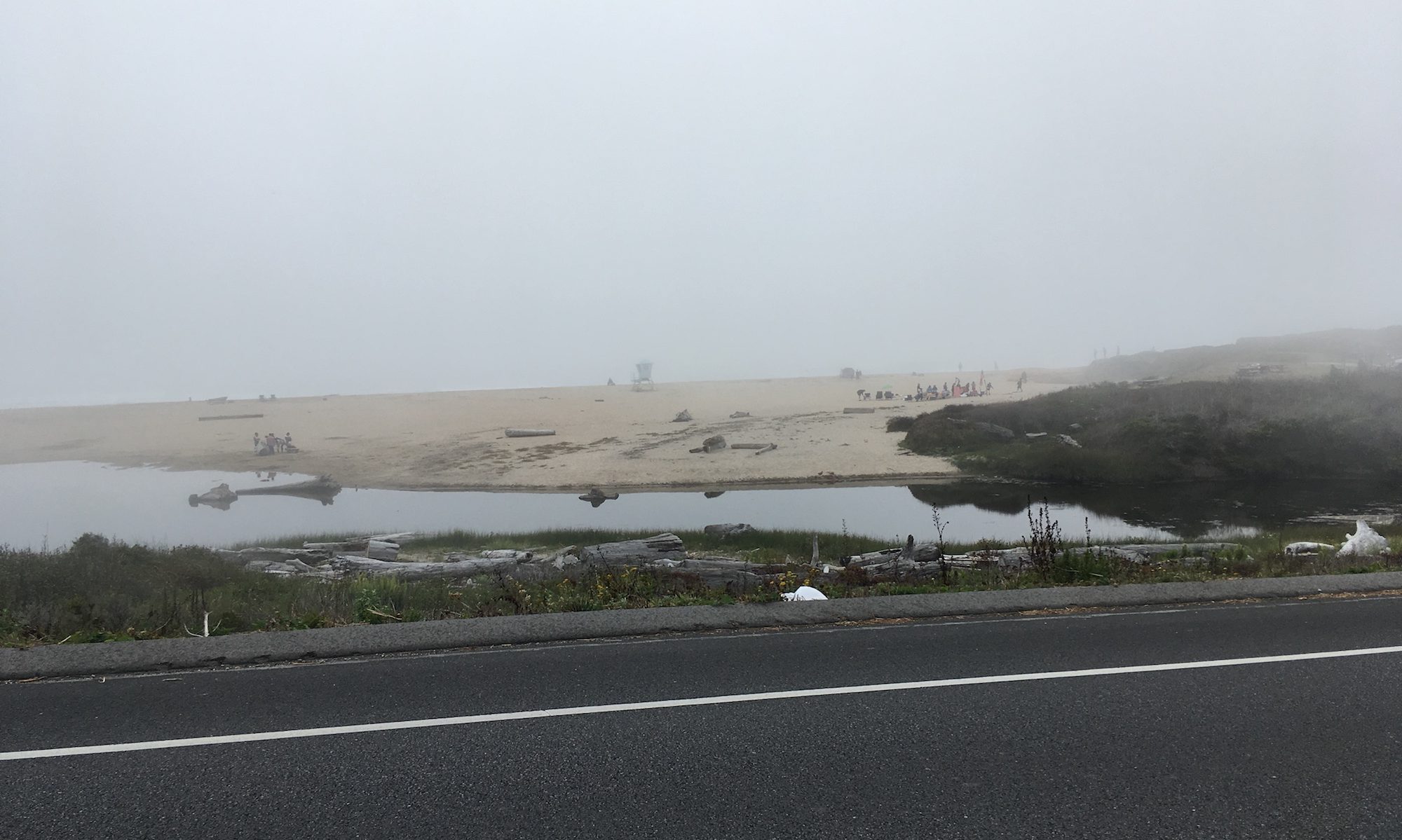
The header is San Gregorio beach, on a day when the fog is up. Around here, it’s the place where you take that special someone you’re getting serious about. For at least a couple of years now, the whole San Mateo coastline has been my refuge, my place of peace, where I go to get my head together. It’s where I idly dream of retiring someday as I drift off to sleep at night. If I went down tomorrow, it’s almost certainly where I’d want my ashes scattered. It feels like a right place, and a safe place, and a saner place.

Which means it’s a good header for here. Twelve years of journaling here has made me acutely conscious that I spend a lot of time bitching and woolgathering and raging against the storm to no good end. Maybe hanging this over the front door is a good way of reminding myself that there’s a better place and a better aspiration and it’s a half hour to get there…unless I stop at Taco Bell in Pacifica first for a loaded potato griller and some Cinnabon delights with an extra large Baja Blast.

Year 13 is begun. Onward.

eeeeeeeee mail

In the beginning there was eWorld. I knew the internet existed, and that I would have access to it when I got to Vanderbilt, but having just bought my Power Mac 6100 my thinking was “get online as quick as humanly possible” and that meant the short window in which Apple had its own private-label version of America Online. It hadn’t been up and running more than a month when I got on, and while it didn’t really have internet access, it did have an email gateway. And so history will record that my first email address wasn’t @vanderbilt.edu, but @eworld.com.

I got my Vanderbilt email within hours of arriving on campus, of course. It took a while for me to figure out how to get my computer dialed in with Apple Remote Access and then configure the necessaries to telnet in from there, and then it took me a while to figure out how to actually use Eudora. But for the first three years of my online life, email was something that I had to find a computer with a command line to access unless I was at home. So telnet became the indispensable thing, from any one of half a dozen places around campus. Being home meant being without access. Which was painful.

The big shift occurred when I got to Washington and realized I needed to be on IMAP rather than POP. Vanderbilt was just engaging in that shift as I left, moving from telnet and POP to an actual IMAP client. Webmail existed – I had a burner Hotmail account almost as soon as I found it existed, and that was potentially transformative – but Vanderbilt didn’t, and neither did my new ISP in DC. In fact, I specifically chose them because they had command line access, and that remained my essential backup solution for years after, Sure, there was Eudora – or Outlook Express, or whatever alternative client I grasped at before Apple Mail in Mac OS X ended Email Client Glee for good – but I felt naked without the ability to just telnet in and use pine.

And it stayed that way. I had POP mail clients on my phones from 2000 on, with varying degrees of success – mostly only useful as an enhanced pager of sorts, or to see “oh shit I have to get back to my computer and look at this for real”. My early smartphone attempts – the Sony Ericsson P800, the Nokia 6620 – didn’t handle it much better. It was only once the iPhone landed in my hands in the summer of 2007 that I realized that email was no longer something you got at over the terminal or through a web browser: email was now something that lived in your hand.

And here’s the remarkable thing: through all this time, email remains the only thing you can set up yourself, on a server in the closet, and make work on any platform or interoperate with anyone else’s email. If you could drop back through time and send something from that @eworld.com account, it could be received and read equally well on Gmail, on the mail client of the iPhone, on Outlook at work, through pine at this very host. Nothing, not even SMS, has been as robust and as interoperable for as long. And that’s why I still persist in keeping up my personal addresses and doing the work to train away the spam, because after almost a quarter-century, I still perk up at that “unread” indicator.

Glee gone by

During the blog outage, I was messing about with the Nokia 3310 and decided to compare it to the Nokia 6620 or Motorola V635 via phonescoop.com, which used to be an everyday visit once upon a time. Sure enough, for a $60 burner phone in 2018, it could go back in time to January 2006 and it would be a killer. Everything I wanted in a phone twelve years ago except possibly iSync (and let’s be honest, iSync was crap): quad-band coverage for home and abroad, Bluetooth AND speakerphone, an equal-or-better resolution display and a battery 50% larger than anything else I had, and all in a package half the size. A memento mori of the time when your cellphone went in the change pocket of your jeans and manufacturers were competing to get smaller.

But then, there’s a lot of things I don’t have the same glee for anymore. Time was, I was on the eternal search for the perfect bag. Constantly looking at Timbuk2 and Rickshaw and Chrome for all manner of what have you. Messengers, backpacks, the One True Bag that would sort it. And then about five or six years ago, it stopped. Partly because I didn’t need to carry a laptop every day any longer, but partly because I ended up with a small backpack that was just what I needed for work and no more, and because I had a Rickshaw messenger for an overnight bag and a Timbuk2 that could go for two or three days (in fact, I am actively contemplating a Monday-through-Friday with nothing else). 

There was jacket glee. That mostly passed as a result of eventually accumulating everything I could have wanted. The Filson/Levis trucker jacket. The long-sought-after Harris Tweed. The seersucker blazer. The Buzz Rickson, imported from Japan in person. The peacoat, after all that time. And the thing that kills me is that thanks to climate change, I rarely need anything heavier than a rain shell. I’ve gone from a world where I defined my look by my outerwear to one where outerwear is superfluous to requirement.

Well, how about shoes? I accumulated those too. I eventually got my British-made DMs and DM-alikes. The quest for American footwear got me some canoe Mocs and the Alden Indy boots, both of which will be remanufactured for the rest of my life as required. And by a weird stroke of luck, I fell ass-backward into a $35 pair of plastic Birkenstocks which fit and wore so well that I bought two more pair to have stashed in the closet for when the time comes that the first ones wear out.

Which is a recurring theme. It seems that for the last two years, almost, my clothing purchases consist of “stockpile more of the basics.” The Pointer Brand jeans from LC King of Bristol, TN, basic American workwear for a century. The black T-shirts from American Giant, with their slubby cotton weave. The overbuilt work shirt from AG that became almost an everyday garment when I wasn’t in the office from January to June, every chance I could get when the temps were going below 66 degrees. (And yes, there’s a spare still sealed in its plastic in the closet.) I suppose you could make the case that Hat Glee overpowered all other clothing fixations, but the two wool flannel caps and the tweet flat cap from Ireland very nearly put a sock in that as well (special souvenirs like the San Jose Churros lid notwithstanding). 

I didn’t learn not to want stuff. Not at all. This is not me moving past material concerns. But there’s a chance that I’ve accumulated as much stuff as I need or want. I really like the car, I really like the work shirt, I really like the three pair of footwear that do for most everything anymore. If allowed, I would just wear the same five black T-shirts and same three pair of jeans until they wore out. My three wool caps – two flannel baseball, one tweed flat – obviate the need for any of the others. I have everything I require or desire to get through life, and at this point, the money is all for plane tickets and lodging and bar tabs. (And Kindle books and iTunes content, to be honest, but that’s not taking up any more space.) It’s possible that the things of the world finally dovetailed neatly with the life I’d like to lead.

anchor, down

To be perfectly honest, I don’t have that many great memories around my time at Vanderbilt. Not that the ones I do have aren’t great, but there just aren’t that many of them, because of how I wound up spending way too much time back in Birmingham indulging my toxic relationship. I can only remember attending two actual football games in three years, even though I know there must have been more. I remember a handful of departmental team outings – to the movies once or twice, to the Oak Room, bowling, two or three random house parties or dinners. Mostly I just remember being –  whether on campus at the Overcup Oak or the computer lab at Payne Hall, or walking distance at SATCO or Boston Market, or at one of the malls or just wandering around the Opryland Hotel in search of that Disney World vibe. It was just the fact of being in Nashville, being at another school, feeling like I had found this alternate world that wasn’t bounded by Jefferson County Alabama. One where I was happier than I’d ever been in undergrad. Like I’d stepped out of my own time into a better one.

I know in the past I’ve said that Nashville felt like home on day one in a way no other place ever did, but upon further review I’d like to extend and revise my remarks. See, it was Vanderbilt that felt like home on day one. It just happened to be in Nashville, which added to the novelty of it all because I was on a college campus I hadn’t already been visiting weekly since 1978 or so. But Vanderbilt was a highly-regarded academic institution where I’d been awarded a scholarship and was being left to my own devices without the burden of being in the same town or having felt like I flopped to my second choice. It was, simply put, the fulfillment of my life’s work. No wonder it felt like home. 

So when the bubble burst and I came back to earth – and then had to start all over and be rebuilt completely anew somewhere else – Vanderbilt sort of went by the boards. I was vaguely aware of them getting off to that great start in football in 2005 (only to come back to earth hard) or reaching his-and-hers Sweet Sixteens in 2004, but my actual undergrad and Alabama football held at least as much of my attention throughout my time in DC. (When the Skins weren’t soaking it all up. Or NASCAR, how the hell did that happen. For that matter how did I never make it to one Skins game in seven seasons in Arlington?) It was only once I’d spent some serious time in Silicon Valley, caught between Berkeley on one side and Shallow Alto on the other, that I gravitated back toward my consolation-prize M.A. as something more than just degree laundering.

Thing is, my Vanderbilt stuff in recent years has been tangentially related to my time there at best. I’m not in contact with any of the Herd, my old colleagues and cohorts, or any of the faculty I kinda sorta not-really worked with. I’m not involved with my field of study at all, never have been since leaving. I’ve been sporadically involved with the San Francisco alumni club, though I’m largely out of the demographic for that, and of course there’s the blog-and-Twitter content which has become more sparse than ever. I’ve been back since graduation, obviously, but for the first couple or three times it was just a bookstore run with someone else in tow. That 2012 football game was my first trip back alone since I left alone in 1997, and I think it was the echoes of that which I felt more than any real “it’s like I’ve never been away.” Or more accurately, it was as if, having become a devoted fan of some foreign soccer team, I finally got to visit their stadium in their own country for an actual game. Except for the ring on my finger, I could just as easily have been one of those rare precious sidewalk alums, someone who picked Vanderbilt out of a hat with no connection other than wanting to support them.

Which has always been kind of a tough nut to crack. I’ve never settled on any team I wanted to root for without some sort of connection. I think that was what made the ten-year search for a Premier League team so inconclusive; it required me to have a nagging attachment to Fulham, attend an actual home match, and see their ultimate promotion back to the PL to give me a confirmed rooting interest. I had my wife for Cal, I had the Irish pub and its song connections for Celtic, I had political science and my then-girlfriend’s grandfather for the Skins before I ever landed in DC. Vanderbilt was something I went back to at the moment when Bama was a steaming pile and I’d finally entirely disavowed my undergrad, a time when I needed some connection to which I could feel like I had a legitimate claim.

It’s gone kind of sideways in recent years. It doesn’t help that the general toxicity of Twitter has bled into that account as well, but my billet on the blog was football, and it’s become intolerable to be a regular correspondent for a team that has absolutely no shot in its conference, in a sport that embodies the worst of college athletics and may be on the same course as boxing for what it does to the health and welfare of its participants. In a world where the Dores can field three other legitimate national championship contenders in other sports, there’s no percentage in signing up to get your brains beat out in hopes that maybe this is the year football can maybe reach .500 somehow.

I mean, if you think about it, how much of my Vanderbilt life nowadays actually existed when I was there? There was no Twitter. There were no blogs. There was barely a USENET presence. No one had ever heard of “Anchor Down” or “Who Ya Wit” and the three-finger gesture didn’t exist except as a Serbian nationalist sign. Vanderbilt, for me, since 2007 – and especially since 2010 – has existed mainly as a way for me to have something to claim to belong to, something I can point to when people say “tell me about yourself.” It’s become an attempt to reach back and fish something out of the black hole, to built some kind of ersatz college experience that could stand in for seven years of trying and failing to have what I’d always wanted and twenty more of chasing behind it. And somewhere in the last year, the college thing became something I learned to stop really caring that much about. College happened, it didn’t work out like I hoped, and there’s nothing for it but to walk on and do whatever is next.

In fact, there’s an argument to be made for Vanderbilt not as college-laundering, but as the first job out of college. Sure, it was a job as a grad student, but they were paying me to do it and giving me a salary and health care, I could have lived anywhere in Nashville, grad students weren’t remotely tied to what you think of as student life…and the thing is, viewed from that angle, the arc of my career path is FAR more impressive if you launch from just a failed four years at a nothing school in Alabama and get all the way through Vanderbilt and DC to Silly Con Valley. I don’t have to tether myself to it as some bulwark of identity. I don’t have to keep forcing myself to fit someplace that is honestly not that great of a fit for the sake of filling a black hole that I can just plank over and walk around.

Vanderbilt was something that I settled on at the exact moment when I was casting about for an English soccer team, and I think in retrospect it was for many of the same reasons. It was something new, unique, novel, a rooting interest I could claim anew somehow. It has been its own variety of cosplay, its own sort of invented secret identity to let me pretend to be something more or different than I actually am. It was something I salvaged out of the old wreckage, slapped a couple coats of paint on it, and used to try to prove I was something else. And we may well be approaching the day when my Vanderbilt identity, as currently constituted, will be a casualty of my lifelong ambition not to have to prove anything…which began at Vanderbilt.

“Is it safe?”

So about a month ago, Thanos snapped his fingers, and half the server was destroyed. Fortunately it was the OS half and not the content half, and thanks to the diligent genius work of Mine Host, we are back in business just in time to start the 13th year of this blog. Which is kind of crazy to think about. It’s my longest continuous online presence at any one address other than my iTools mail account. I’ve been using this URL longer than any cell phone number (to my wife’s endless chagrin).

We have so much to catch up on. Remedial posting begins tomorrow.