Sic transit…

Whenever the topic of death comes up, I always think that the experience of losing someone close to you is something that plunges you into a deep dark place – and the person that surfaces is never the person who went under.

For Ted Kennedy, too much of his life was shaped by death. One hopes that he finally found refuge from all the ghosts.

With him goes virtually the last fighter from an era of pre-Vietnam muscular liberalism – an era of happy cold warriors who saw nothing wrong with drawing lines in Berlin, or Cuba, or Southeast Asia, while bringing the same sort of crusader instinct to the home front on things like racism and poverty. There was an age when people believed that you could literally do anything and everything – heal the sick, make the lame to walk and the blind to see, walk on the moon, make the poor at least moderately comfortable if not reasonably affluent, have black and white hold hands in harmony and drive the Reds out of the peace-loving nations of the world.

At some point, we ran up against our limitations as a country, and in too many ways and too many places, we somehow decided that if we can’t succeed, we shouldn’t even try. Ted Kennedy was a memento mori of those limits, but he was also something like the ghost of a guilty conscience – a reminder that there was a time when possibility was endless and America’s goals and dreams weren’t measured out in feasible expectations and half-loaves.

I wrote a few days ago that Ted Kennedy would probably have been gone from the Senate years ago had some sort of national health care passed. Something, anything – full-on NHS-style socialized medicine, national single-payer, some sort of pool-plus-mandate-plus-subsidy hybrid, anything, just as long as every American could see a doctor when they needed one without feeding their entire worldly livelihood into a chipper-shredder and going bankrupt. It’s probably just as well that the cancer got to him first, because seeing the dream deferred yet again after almost five decades of trying…well, watch your life’s work run on the rocks for fifty years and see how well you take it.

There’ll be time enough to grill later, but for now, house rules state that everybody gets a free pass across the river. Hopefully the boatman brought the Chivas.

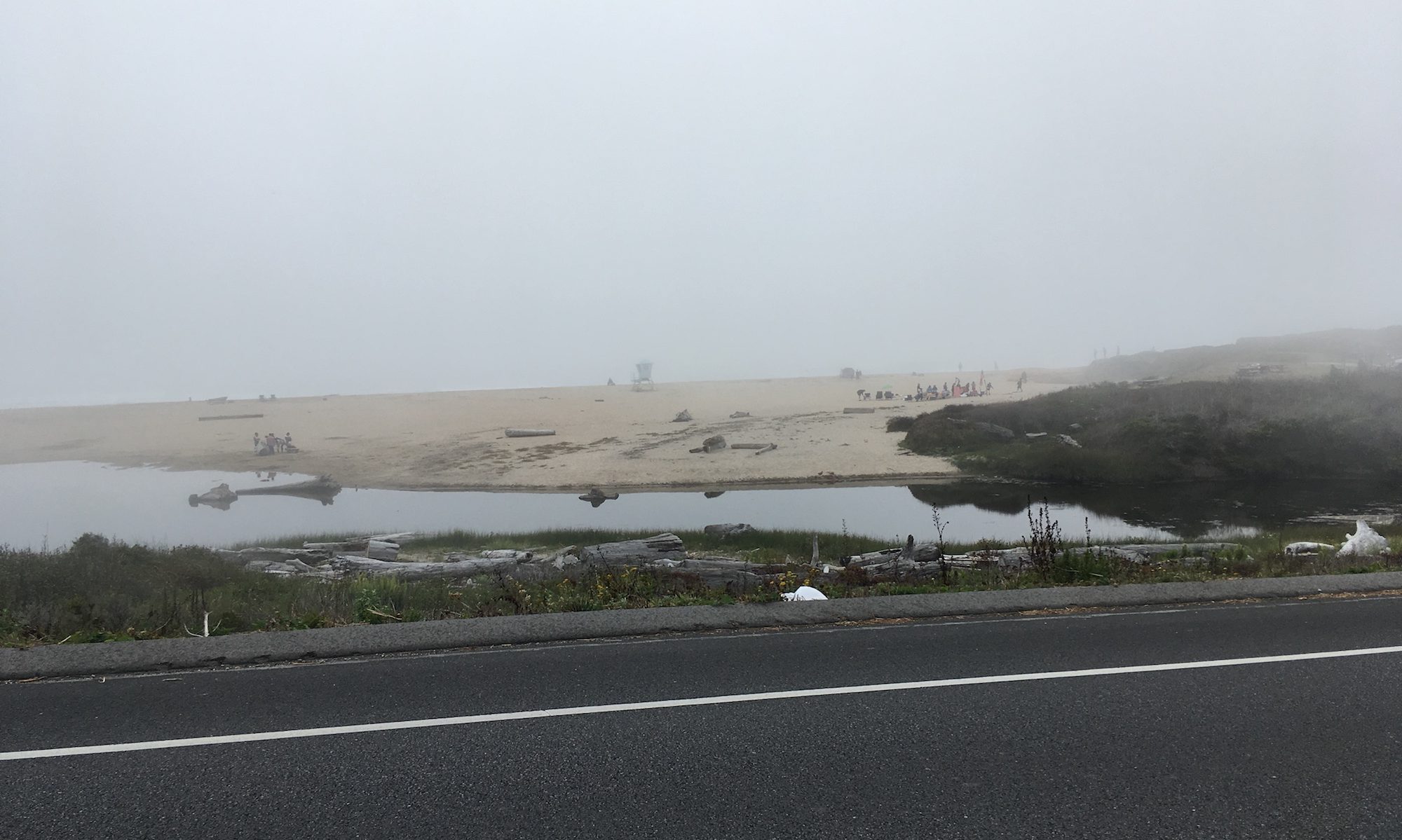
Fog and the beach

It’s sunny out now, brighter than at any point all weekend. For somebody who gets reverse-SAD and is actively depressed by the heat and the humidity and the direct sunlight, this is not a good move. It’s been a decade or so since the beach meant warm sunny weather and bodysurfing and the like – living in close proximity to San Francisco, Half Moon Bay, Pacifica and the like has led me to think that cool and overcast with “marine layer” is the default state of the ocean. And honestly, I’m really OK with that. I would much rather see the surf from under a jacket with a bracing dose of Scotch whisky to hand, with the cool comfort of sea mist drifting in with the sunset.*

But at the moment, the sun has broken through the clouds, there are sparkles on the breakers, and the blogging pit at the beach house is starting to get uncomfortably warm with a good three hours of sun left and the light streaming directly through the windows. Not really the desired result, but then, I guess you can’t have everything. I confess this beats the hell out of the old style of beach – the chaos of the Redneck Riviera, the endless plethora of airbrushed T-shirts and salt-water taffy and go-kart racing. The quiet-solitude approach to beach vacationing suits me infinitely better, which I guess is a testament to the desire to get into 5-space and make everything else disappear for a while until I can recharge.

Pace those endless drives of the previous post, I’m wondering whether the prolonged road trip served the same purpose in the old days. Just me, a car, a radio and some terrible junk food, and a long way to go. Problem is, in the old days, it was an easy way to wind up too much in my own head and spiral out into all manner of unhealthy mental digressions. These days, the most driving I ever do is on autumn Sunday afternoons when I decide that the gas burned driving around listening to Sam and Sonny calling the game on satellite radio is ultimately going to be less expensive than heading down to Dan Brown’s to watch the big screen and wash away the misery in cut-rate Guinness.**

If I had the money, retiring to the coast somewhere in the vicinity of HMB and parts north would be ideal, especially if I could retire today. I may have to settle for visiting the city in the Sunset or Richmond and parts west to get my fog fix, though…I don’t think I can afford to quit work right now.

* At this point the evidence of my ethnicity should be insurmountable.

** Seriously, how much proof do you people want?

Point of curiosity…

From Apple’s response to the FCC:

The application has not been approved because, as submitted for review, it appears to alter the iPhone’s distinctive user experience by replacing the iPhone’s core mobile telephone functionality and Apple user interface with its own user interface for telephone calls, text messaging and voicemail. (emphasis mine)

I believe one of the features of Google Voice for Android, on T-Mobile’s G1, is that you can opt to route all your handset phone usage through Google Voice. I don’t know what that gets you, other than the GV number, direct access to GV SMS and cheap international dialing, but nevertheless, I strongly suspect that there is something similar in the GV app for the iPhone. Given the terms of service explicitly stated for iPhone apps re: replacing core functions in the phone, if that is in fact the case, then it’s no bloody wonder the app has not been approved.

GIven the circumstances described re: the number of applications being reviewed vs. the number of staff reviewing, it’s obvious that the “working 90 hours a week and loving it” mentality is alive and well on 1 Infinite Loop, Himself or no Himself.

News!

It’s not often I have housekeeping news, but today I do. My kind host who hooks me up for free is making the move to MT4 as part of the migration to a new server, and I am taking the opportunity to clean up some stuff.

Going forward, the old RSS feeds (esp. in LiveJournal) may break, so you need to hit up this lovely site from now on at either:

http://www.iwasmisinformed.com

or

http://staggerlee.org

Any modern browser should give you the automatic XML option to put into your feed reading device as well.

Onward!!

100% No Fun and Out to Eat Your Soul in the Name of the Socialist State*

Universal heath care has been out there as the great liberal hope since the age of Roosevelt. Its roots as a concept go back all the way to Bismarck’s Prussia, and FDR reluctantly cut it out of what became Social Security in the 1930s. Almost all Democratic Presidents since (and a few Republicans) have tried to move the ball on increasing the public role in providing health care, with varying degrees of success – but the most recent effort, in 1994, is the one that sticks in the public mind. The American public was told that if “Hillarycare” became the law of the land, you wouldn’t be able to pick your doctor and faceless bureaucrats would be in between you and your doctor. So Hillarycare went down to defeat…and we got all the threatened side effects after all with none of the benefits.**

The key thing that makes the US different from all other major industrialized nations is that our system of health care provision largely came about as a result of wage and price controls during the Second World War. Unable to offer money, employers instead began offering health insurance coverage to employees. Somehow, the notion that your health coverage is provided by your employer became more or less standard, proving the old French maxim that “nothing lasts as long as the makeshift.” And employee-paid insurance covering fee-for-service medicine was more or less the way things went for the next fifty years or so.

The situation became more complicated with the rise of HMOs as the keys to containing health care costs. Almost all employers replaced classic indemnity coverage with some form of HMO or PPO in the 1980s and 1990s. The biggest problem with this is that large-scale for-profit provision of health care services breaks in the free market – one doesn’t normally shop for kidney replacement surgery the way one would price watermelons or tennis shoes, so comparison shopping and competitive pressures are diminished. Worse, though, is the fact that making a profit depends on taking in more money than goes out – which means that for-profit HMOs and insurers have a financial disincentive to provide the services their customers pay for. When a company’s financial health relies on not providing the goods and services for which it is paid, something has broken down in the world of capitalism.

For some reason, there is a general consensus that moving to a system of government-run health care is beyond the pale and not open for discussion. Fine. The Brits seem to be perfectly happy with the NHS in the main, but that’s had sixty years to become an institution. Right now, the far horizon of discussion is universal single-payer health insurance (i.e. the government becomes everybody’s insurance company) and various measures short of that are being kicked around.

Personally, I don’t know what the best option is. These are the things in the forefront of my mind, though, and I would like to see them addressed at some point in the process.

1) A lot of people have said that administrative costs are a big part of the growth in what we pay for health care in the US. This is not surprising for several reasons. Anecdotally, I can say for myself that getting reimbursed from one’s Health Savings Account varies from irksome to right-royal-pain-in-the-ass, and I can only imagine what it’s like for a doctor’s office that deals with a dozen different insurance companies, all with unique forms and different co-payments and varying requirements. I would not object to a single-payer system, irrespective of who ran it, just for the sake of not having to deal with all the damn papers anymore. And God help you if you go through three different insurance providers in 18 months and have to sort all that out. Anything that can reduce the paperwork – some sort of standardization of forms? Some sort of info portability (see below)? – would be an unalloyed good.

2) I realize that it’s a potential IT security nightmare. I don’t care. In the year 2009, a country that put a man on the moon forty years ago with sliderules and adding machines can bloody well figure out a way to handle a patient’s medical information that goes beyond “a big manila folder with colored tabs on the side.” It is absolutely crazy that anybody can pull my credit history in about thirty seconds but it takes a couple of days’ worth of faxes and phone calls to get my chiropractor, my physical therapist and my orthopedic surgeon on the same page.

3) If you take regular medication, it should be butt-simple to get on a system where you get the drugs mailed to you instead of standing in the damn line at Walgreens every month with the extras from the Star Wars cantina.

4) In the late 1980s, “cat health” was added to Medicare – in exchange for a small increase in premiums, things like prescription drugs coverage and complete coverage for catastrophic health incidents were added to Medicare. It was a great scheme – the axis of Reagan and Rostenkowski angling for a repeat of the Gucci Gulch victory of 1986 – but within a couple of years it was repealed, because the people who were going to benefit from it balked at paying any more. Fifteen years later, a prescription drug benefit – unfunded – was slapped together as Medicare Part D, and as for catastrophic coverage? Well, medical expense is now the number-one cause of personal bankruptcy, so plainly something got lost along the way. People need to get familiar with Luckett’s Law: “shit costs money.” Everything – health insurance, tax cut, F-35 fighter jet, fine bottle of 18-year-old Jameson’s – costs money. And some things are worth paying for (the Jameson’s, for instance, which is about the only way you can come home with an 18 year old and not get your ass beat down).

5) The same year that I got married, I also got a will and an advance health care directive. I was 33. If you’re married – hell, if you’re not married, and especially if you have kids in either case – you should have both. The time to think about whether you want to “live” hooked up to a machine in a 10-year coma is not after you’re comatose. You should have a plan, in writing, notarized, and you should revisit that shit on a regular basis in case it suddenly doesn’t seem like such a good idea for your ex-boyfriend to be the one in charge of whether you get put on the heart-lung machine or not. Should the government make this kind of advance planning mandatory? Well, obviously not. Should they make it as cheap, simple and easy as a Chi O on bid night? Hell yes.

6) If I get one more call from the pharmacy saying that they need a doctor’s authorization before filling my order, I will take a hostage. You have a doctor’s authorization, ass honk, it’s called a prescription. Shut up and give Daddy his pills right fucking now. (see #3 – ed.)

7) The way insurance is supposed to work is that you have a bunch of folks paying in but only some of them pulling out at any given time. This is one place where the economy of scale actually works in health care – the more people you have in the pool, the better off you are. Something that lets small businesses team up into one big thing that gives them GM-size negotiating power with insurers is probably a good idea, whatever form it takes.

8) There is a very good case to be made that General Motors went under because it was no longer a car company – it was a retirement fund and health insurance provider that tried to defray costs by building vehicles on the side. The figure of “$1500 a car” gets thrown around as the premium paid for a car built in a country where the company is paying for the health care, and I don’t know how accurate it is, but I will bet you any money that if GM didn’t have to pay for the health care of its workers and retirees, it wouldn’t have gone bankrupt. The question of whether the employee’s share of taxes for health care would be covered by just giving them the cash difference that GM was paying is one I am not qualified to answer without a lot more time in the books with Excel and Excedrin, but it merits thinking about (viz. #7 above).

9) “Anybody can go to the emergency room” is not a universal coverage plan. For one thing, ER-based medicine could not be more expensive if it came wrapped in unicorn eyelashes and soaked in dragon tears. For another, the sorts of folks who only go to the ER, and only as a last resort, are probably the least likely to be able to pay for it later. Look at it like this: would you rather pay to change the oil, or wait until the engine blows up and pay for a new one? Now, if you have to choose between paying for somebody’s oil change or their engine rebuild, which would you rather get stuck with?

10) Looking around the world, there are a lot of different systems and a lot of ways of doing things. But if you look at the other industrialized nations, two things stand out: 1) Nobody else copies our system. We are the only ones who do it like this. 2) Nobody spends as much money on health care as we do, and yet nobody seems to have appreciably worse health care overall. There may be something to be said for looking at what other countries without single-payer or single-provider do, how it works, and whether there is anything worth considering for our own future use. Remember Jobs’s Axiom: great artists steal.

11) I don’t have any answers. I am open to suggestions. (Note that spittle-flecked invocations of socialism do not count as suggestions.) All I know is that if we can find some way to spend less money on this stuff, it will be easier to handle all the other problems coming down the road in future (the forthcoming physical infrastructure collapse, the ass-backward broadband and wireless coverage in this country, the inevitable inflationary pressure when the Fed tried to reel in the post-stimulus oversupply of money, etc etc).

12) I have a one-inch crack in my skull from puzzling all this out. I just figured out the banking thing this weekend, that’s how zippy I am.

* Team Black Swan East gets a nickel. I told you he was smart.

** You may or may not see this as a benefit, but it’s pretty much a lock that Ted Kennedy would have retired ten years ago had universal health coverage become law.

Flashback, part 11 of n

Millenium.

It was a word to conjure with. 1999, the edge of the Great Odometer Rollover, the dawn of the 21st Century (if you’re going to be pedantic about 2001, feck off) – the arrival of The Future.

And it really felt that way. We had the Internet, the World Wide Web, all sorts of knowledge right at the fingertips. We had phones small enough to fit in your pocket that worked all over the country and could call any number, no long distance, no roaming. Music was only a couple of clicks away – okay, more than a couple, but if you could get Napster working, a little time and patience would get you all manner of free songs. And if it didn’t, well, there was always a whole wide world of FTP sites and search engines that, let’s be honest, were more safely navigated on your Mac.

And that was going well, too – I was rocking a Powerbook G3 Series 233 Mhz, 14″ screen, with 96 MB of RAM and a whopping 2 GB drive – the same processor and RAM as the desktop machines, and just about as fast a machine as you could buy for $2000. Apple was definitely NOT dying – hell, in two years, the stock had gone from $15 to $125. But then, the tech sector was running away – Amazon, Netscape, all manner of companies that couldn’t have existed five years earlier were now pushing the stock market to dizzying levels.

I distinctly remember sitting in my cube at work, using my time and effort during the day to seek out and find new MP3s to download – and when those ponderously long downloads started, I would run out and troubleshoot Palm III handhelds for people who couldn’t grasp that when you brought your laptop back, you had to plug the cradle in before your Palm would sync.

And the free stuff! Free dialup ISPs. Free DSL in some places. I think a couple of donks got free cars. Advertising was going to drive everything. Peapod. Kozmo. You would get stuff delivered. No more grocery shopping, hell, no more runs to the 7-Eleven! God, what I would give to have that back up and running.

I think Web 1.0 was largely a transitional phase – even things that were classed as a “pure Internet play” were largely just taking meat-world goods and services and selling them on via the Internet with no actual brick-and-mortar presence. In a world where the hottest machines were barely a third of a gigahertz and the hottest connection was ISDN, *real* pure Internet plays, things that only exist as Internet phenomena – things like social networking and digital music – weren’t really on the cards. Similarly, the next big wave of ingenuity depends on enough smartphones out there for critical mass. Don’t forget that things like Bluetooth and DSL and satellite TV and digital cable and hybrid cards all *existed* in 1999 – they just hadn’t reached anything like critical mass. Or, as a wiser man than me put it, “the future is here already, it’s just not evenly distributed.”

Which is why 1999 was when I first started thinking about moving to the thin end of the distribution. Or, put differently, the bleeding edge.

O-4-Rated

BRETT FAVRE IS NOT BIGGER THAN THE NFL.

Ideally, I would love to see him doused in worcestershire sauce and locked in a room with Michael Vick’s dogs. The decidedly unChristian part of me would love to see him take his first snap from scrimmage in an exhibition game and go down with two broken legs.

Brett Favre is no longer fit for purpose as an NFL quarterback – ask any Jets fan about the tail end of last season and then plug your ears – and the only reason we are afflicted with Hamlet-in-a-helmet is because the sports media cannot stop acting as if this is somehow a consequential bit of news. This is why I love the Redskins but truly despise the NFL.

I will stop beating this dead horse as soon as ESPN’s done fucking it…

Trouble

So the latest fashion among red-state limpdicks is apparently to stand around conspicuously close to Presidential events brandishing weapons, making much of the fact that they are within the letter of the law. This is basically the equivalent of the six-year-old who waves his hand in your face screaming “I’M NOT TOUCHING YOU! I’M NOT TOUCHING YOU!”

Personally, I don’t have a lot of trouble with the idea of firearms ownership in general. All mine are in the ancestral land rather than here, though, because quite frankly I don’t need them in a place where the majority of folks don’t want to shoot everyone like me. So what the hell is going on in these other places that people feel the need to suddenly just happen to exercise their rights in close proximity to an event that contains most of the things they oppose in one place?

If you remember my previous work, you know that there are essentially three political parties in this country: the Left, the Right, and the South. Until roughly 1964, these were conflated oddly, with most of the Left and the South under the umbrella of “Democrat” and most of the Right under the umbrella of “Republican.” The big shift was the move of the South from the “Democrat” label to the “Republican” from 1964-72, but also consequential was the shifting of everyone that fell under “Left” to the side of the Democrats. Don’t forget that in the Civil Rights era, a lot of the heavy lifting came from liberal Republicans in the Northeast (of the sort known in the early 80s as “Gypsy Moths”) working in concert with non-Southern Democrats. (This is also why the notion of “bipartisanship” is obsolete, with the ideologies having sorted pretty cleanly into two parties with little admixture outside of a few red-state Democrats – there’s a big difference between needing to rustle up 51 “Left” among both parties and having to get 60 Democrats, but that’s a tale for another time.)

In an amazing surprise,* there is a huge overlap between the most virulent health-reform opponents, the “Birthers,” and the population of aging rural Southern whites. This is a population whose doom is written clear as day: America is getting ever more non-white, the South is losing its influence over national politics, fewer than one American in five lives in a rural area, and they themselves – not to put too fine a point on it – are dying. As a cohort, the “South” is in its twilight; the people who voted reliably for Wallace, then Reagan, then both Bushes and finally Palin (note that the ever-so-shocking** “Don’t Blame Me” bumper stickers assert that the owner voted for “Sarah”, not “McCain) are seeing their world and society change around them – politically, culturally, the works – in ways that are insurmountable.

So those folks marching around with their Glocks and their M4-geries and ominous sign-waving about the “tree of liberty” aren’t just out there to decry “socialism” or try to scare people. They have the Southern disease, and are convinced that the world can be made to return to the way it was. They cannot succeed – ask King Canute about tides – but they can make things difficult along the way. After all, if you’re facing an existential crisis, you’ll do whatever it takes to rage against the dying of the light.

The problem is, the last time this particular cohort tried to make things difficult, 168 people died in Oklahoma City. After eight years when you could get bundled off by persons impersonating the Secret Service for having arrived at a rally with the wrong bumper sticker, I personally think that somebody needs to do a better job asserting that while an armed society is a polite society, a polite society frowns on continual public penis-waving. And if the Emily Post approach comes up short, well…the Feds have always got the hydrogen bomb.

(My actual thoughts on the forthcoming health care debacle will be coming along later.)

* WHOPPING GREAT HEAP O’ SARCASM WARNING

** WHOPPING GREAT HEAP O’ SARCASM WARNING PART DEUX ELECTRIC BOOGALEAUX